AI Precision Communication in P…
Pharmaceutical communication is entering an “attention economy” where access is not earned by frequency, but by relevance. The legacy commercial model—built on share of voice and prescription-volume segmentation—assumed that more touchpoints would translate into more impact. That assumption is now structurally unstable, because modern clinicians filter out low-utility signals and avoid interactions that feel repetitive or misaligned with the reality of practice
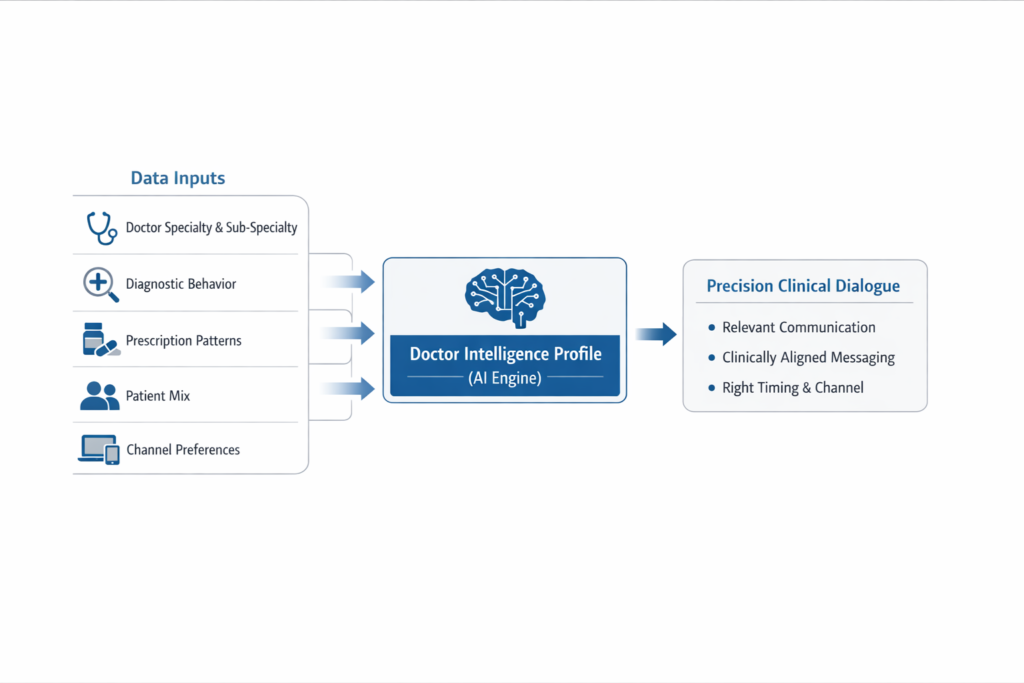
This article synthesizes two research outputs into a single, pillar-style framework for pharma leaders: AI-driven doctor profiling (also describable as a Doctor Intelligence Profile) that enables precision clinical dialogue—communication aligned with a doctor’s specialty lens, diagnostic habits, patient panel, and channel preferences. The goal is not “more messaging.” The goal is better conversations—less noise, more clinical usefulness, and a relationship model that clinicians respect.
Why current pharma communication fails: the relevance gap
The core failure is not “communication fatigue.” Clinicians are information-seeking professionals. The failure is irrelevance—messages that do not reduce uncertainty in a clinical decision and therefore feel like a cognitive tax.
AI Precision Communication in P…
The legacy model: share of voice and decile targeting
For decades, commercial execution relied on frequency: more field visits, more brand reminders, more assets distributed. Physicians were ranked by historical prescribing volume (e.g., “high decile” writers), and engagement intensity followed that single metric.
AI Precision Communication in P…
This creates blind spots:
- A lower-volume prescriber may be a local clinical influencer.
- A high-volume prescriber may have low loyalty and high “message immunity.”
- Patient complexity, diagnostic behavior, and practice context are ignored.
The result: high activity, declining attention.
The omnichannel trap: “omni-annoyance.”
When broad messaging expands across channels without coordination, clinicians stop evaluating each message and start blocking the sender category itself. This “heuristic filtration” explains why uncoordinated omnichannel programs often produce asset fatigue and unsubscribe rather than trust.
AI Precision Communication in P…
Doctors are data-driven decision-makers, not targets
A future-ready model treats the doctor as an expert collaborator—someone who optimizes outcomes under constraints (time, patient mix, diagnostic uncertainty, guidelines, cost barriers). Communication earns attention only when it supports real clinical thinking and real workflow.
That reframing changes what “good engagement” means:
- From persuasion → to clinical usefulness
- From scripted detail → to problem-relevant dialogue
- From “coverage” → to earned access
The strategic shift: from Rx-triggered selling to Dx-informed relevance
A key conceptual upgrade is moving upstream. Traditional commercial logic waits for a prescription signal; precision communication looks at diagnostic intent and patient context.
Medicine follows a causal chain: symptom → investigation → diagnosis → treatment. Prescription data captures the final step; diagnostic signals capture intent earlier in the chain.
AI Precision Communication in P…
Why this matters
If you only react to prescribing, you intervene late—after a clinician’s mental model and workflow are already set. A Dx-informed approach can:
This is also how you find “invisible opportunity,” including the “zero prescriber” paradox: physicians who appear inactive in Rx data but are actually working upstream (testing, referring, investigating) and may be high potential in the right context.
- Identify who is approaching a decision point
- Surface which uncertainty that the clinician is trying to resolve
- Enable educational support that feels clinically legitimate
AI Precision Communication in P…
What AI-driven doctor profiling actually is: the Doctor Intelligence Profile
A modern profiling approach replaces the flat “customer list” with a dynamic, multi-dimensional model—a “digital twin” of the physician’s professional identity that updates with signals across practice behavior and engagement patterns.
AI Precision Communication in P…
The four pillars of a Doctor Intelligence Profile
A robust profile goes beyond prescription volume and incorporates:
AI Precision Communication in P…
1) Clinical philosophy and decision style (how the doctor thinks)
Some clinicians are evidence-skeptical and require strong study design and limitations; others are early adopters; others are strict guideline adherents; others prioritize access and practicality. Profiling captures these “decision archetypes” to shape tone and depth.
AI Precision Communication in P…
2) Diagnostic behavior (the “pre-Rx” signal)
The most important innovation is tracking diagnostic behavior and “pre-Rx” intent rather than waiting for prescribing to happen.
AI Precision Communication in P…
Practical implications:
- When to engage (diagnostic windows)
- What evidence format matters (methodology vs practicality)
- What the clinician is likely trying to rule in/out
3) Patient panel context (who the doctor treats)
A doctor’s practice is constrained by patient mix—payer reality, comorbidities, and care pathways. AI-driven profiling models the “patient mix” so communication reflects real-world constraints.
AI Precision Communication in P…
4) Channel preference and engagement windows (how the doctor prefers to learn)
Even the right message fails if it arrives via the wrong channel at the wrong time. Profiling learns preferred channels, engagement windows, and content formats (deep clinical PDFs vs short summaries).
AI Precision Communication in P…
From profiling to execution: “next best action” for precision communication
Profiling becomes commercially valuable when it drives a single operational question:
What is the best action for this specific doctor, right now—given their context and current signals?
That is the role of a “next best action” engine: it evaluates the profile and recommends the most effective outreach action for a given day (format, channel, timing, and content focus).
AI Precision Communication in P…
What changes in the message
AI-guided communication answers three tactical questions for every interaction:
- What to say: which clinical uncertainty to address, which evidence depth to use
- How to say it: tone and structure aligned to decision style (skeptic vs pragmatic)
- What not to say: avoid redundant or irrelevant angles that trigger disengagement
This shifts engagement from “brand-centered repetition” to doctor-centered clinical dialogue.
A realistic example: an IVF specialist focused on male infertility and diagnostic-first thinking
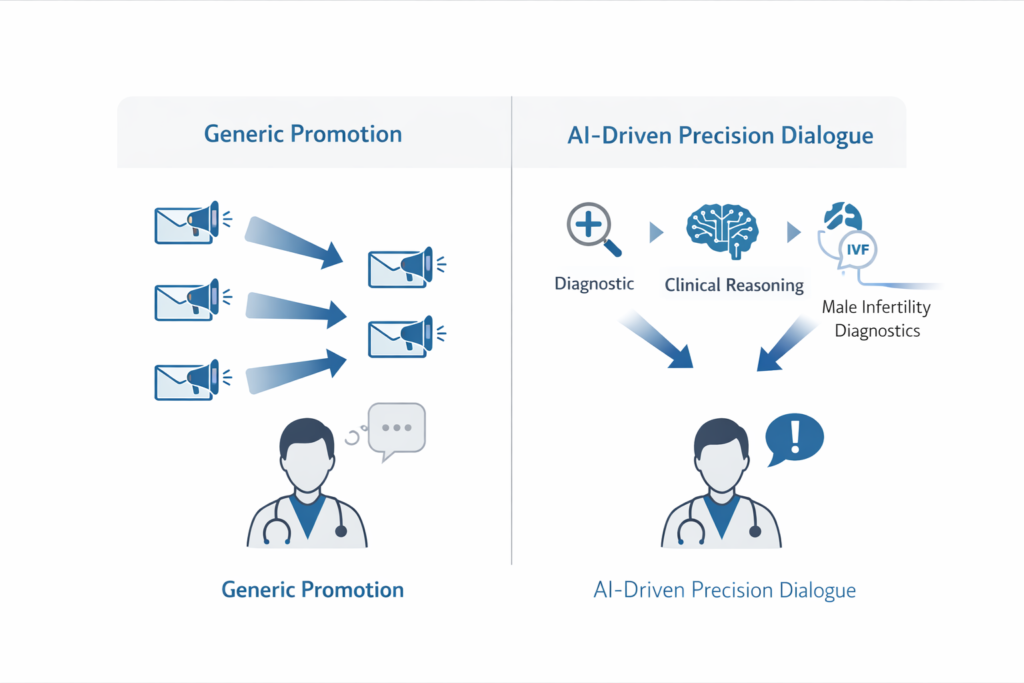
Precision communication becomes clearest when you apply it to a specialist micro-context.
The scenario
Consider an IVF specialist whose practice has a strong emphasis on male infertility and a diagnostic-first approach. A major blind spot in many fertility pathways is the underdiagnosis of male factor contributors, even though male factor contributes to a large share of infertility cases.
AI Precision Communication in P…
Traditional MR-style interaction (why it fails)
A generic fertility conversation often defaults to a standardized script that over-emphasizes one side of the pathway, repeats known information, and doesn’t match the physician’s diagnostic frame. The doctor experiences it as time wasted.
AI-informed precision dialogue (what changes)
With profiling, the engagement strategy changes shape:
What the profile surfaces
- Sub-specialty focus: male infertility case mix
- Cognitive style: diagnostic-first decision-making
- Practice behavior: interest in advanced investigation and causality
How the conversation changes
- Start with the clinical bottleneck the doctor is actually solving (diagnostic uncertainty)
- Offer evidence and pathways relevant to male-factor investigation rather than generic messaging
- Avoid irrelevant content that signals the rep “doesn’t understand my practice.
This exact contrast—generic versus precision—drives higher engagement because it signals professional respect and clinical alignment.
AI-Driven Doctor Profiling_ Fro…
Measurement: why “diagnostic lift” becomes a leading indicator
If engagement is upstream and clinically grounded, measurement must evolve too.
Instead of only measuring prescription outcomes, this model introduces diagnostic lift: the increase in relevant diagnostic activity following an educational intervention.
AI Precision Communication in P…
Why it matters:
- It’s an earlier signal than prescribing.
- It reflects a genuine change in clinical workflow.
- It aligns with a service mindset: enabling better identification and decision-making.
Ethical and compliance-safe positioning: personalization without manipulation
Precision communication creates power asymmetries—so guardrails matter.
A defensible model stays within these boundaries:
- No patient-level targeting: insights must be pattern-based and aggregated, not “I know what you did yesterday.”
- Educational intent: focus on improving clinical decision processes (diagnostic pathways, evidence interpretation), not psychological exploitation.
- Human oversight: clinicians are diverse and context shifts quickly; the field/medical team must retain autonomy to override recommendations.
- Approved content discipline: personalization should remix what’s permissible and clinically relevant, not generate unreviewed claims.
This is how AI-driven profiling becomes a credibility enhancer rather than a trust risk.
AI Precision Communication in P…
Why this is a strategic shift—not a tool change
Treating AI-driven profiling as “just another marketing capability” misses the point. This is a business model evolution:
1) From volume to value
The organizing unit becomes the quality of attention earned, not the number of touches.
2) From product-centric to practice-centric
The commercial organization must understand practice realities (diagnostic flows, constraints, patient context), not only product messaging.
3) From Rx capture to clinical collaboration
The most sustainable relationships are built when the doctor experiences pharma communication as problem-relevant support, not repetitive promotion.
Implementation blueprint for India-focused pharma organizations
India adds practical constraints (heterogeneous practice settings, varied digital adoption, fragmented data). A pragmatic path is:
Phase 1: Build the minimum viable doctor intelligence profile
Start with signals you can govern responsibly:
- Specialty/sub-specialty and practice type
- Engagement preferences and timing patterns
- Aggregated prescribing and diagnostic proxies (where compliant and available)
- Content interaction signals (what evidence the doctor actually consumes)
Phase 2: Deploy “precision assets,” not more assets
Create fewer, higher-quality materials designed for:
- evidence-focused clinicians
- pragmatic clinicians
- guideline adherents
- access-focused clinicians
Phase 3: Operate next-best-action orchestration
Stop running channel programs in parallel. Coordinate them through a single decision layer so physicians experience coherence, not redundancy.
AI Precision Communication in P…
Phase 4: Redefine KPIs
Add leading indicators like:
- engagement quality (time spent, return interactions)
- diagnostic lift (where appropriate)
AI Precision Communication in P…
- access recovery (repeat willingness to engage)
Conclusion: precision clinical dialogue is the post-access strategy
The future of pharma communication is not louder messaging—it is clinically aligned, behavior-informed dialogue. AI-driven doctor profiling (Doctor Intelligence Profiles) provides the architecture to move from:
- share of voice → to share of mind
AI Precision Communication in P…
- omnichannel noise → to coordinated relevance
AI Precision Communication in P…
- Rx reaction → to Dx-informed support
AI Precision Communication in P…
For India’s pharma sector, this represents an authority-building strategy: earn physician respect by communicating like a clinically literate partner who understands how that specific doctor thinks, diagnoses, and practices.