1. Introduction: Problem Framing and Relevance
Artificial intelligence is improving decision-making in many industries, especially where leaders can learn quickly from data and adjust course. Pharmaceutical management has been slower to bring AI into the places where strategy is made: leadership meetings, brand steering, resource allocation, and long-term planning. This is often described as a technology gap. It is more accurate to call it a managerial gap.
Most pharmaceutical companies already have data. They also already have analytics teams. What’s missing is a management design that makes AI insight usable at the top. Senior leaders often receive reports that arrive late, don’t connect across functions, and don’t translate into clear options. Meanwhile, teams on the ground operate with partial visibility and delayed feedback. The outcome is predictable: strategy becomes a set of fixed plans, and execution becomes a set of periodic reviews.
Your concept points to a different view. AI should not be treated as a replacement for judgment or leadership. It should be positioned as a decision-support system that improves managerial clarity, market intelligence, and organizational alignment. In practical terms, this means building a leadership rhythm where decisions are continuously informed by signals from the market and the organization, not only by calendar-driven reports.
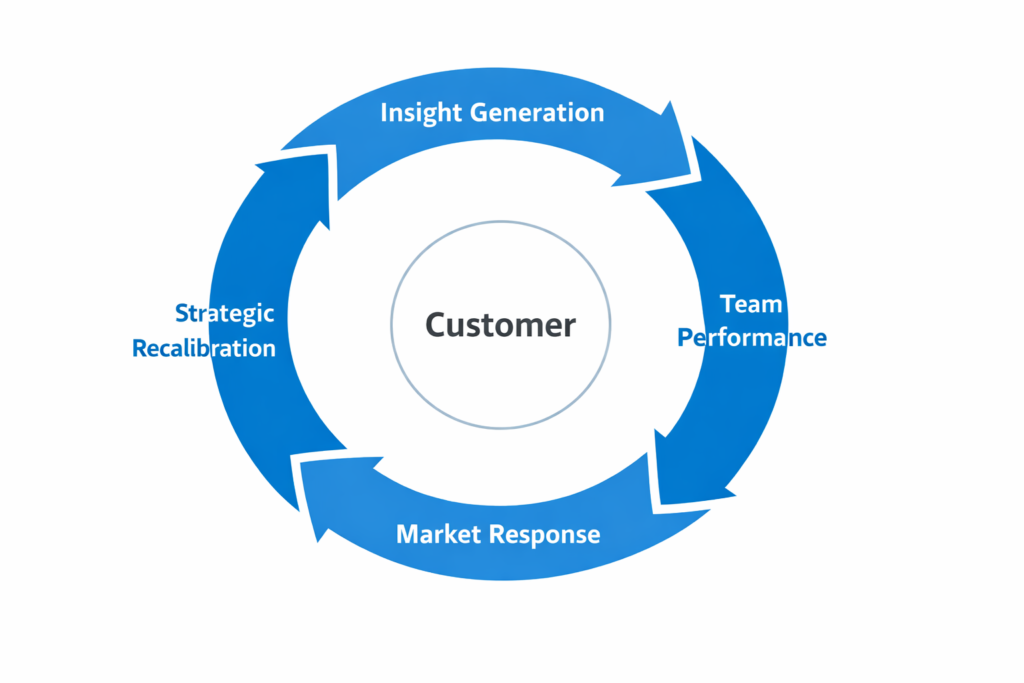
This article proposes a conceptual “blue-wheel” management model for pharma: a continuous decision loop that runs through insight generation, team performance measurement, market response analysis, and strategic recalibration. The customer sits at the center of this wheel as both the starting point and the endpoint of value creation.
2. Conceptual Background: AI and Pharmaceutical Management
In management terms, AI’s value is not limited to automation. Its larger contribution is the ability to convert scattered information into coherent signals that managers can use. In pharma, this matters because decision-making is inherently complex: multiple stakeholders, long planning cycles, sensitive regulations, and high execution dependency on field teams.
AI can help leaders handle three practical realities of pharmaceutical markets:
First, markets change faster than reporting cycles. Traditional planning assumes stability. Modern pharma markets do not behave that way. Payer policies shift, competitor moves arrive suddenly, channels evolve, and field feedback changes weekly.
Second, decisions depend on cross-functional alignment. A strategic choice in pharma is rarely “owned” by one function. Brand, medical, compliance, supply chain, and sales execution all shape outcomes. AI becomes valuable when it helps leadership see interdependencies rather than isolated numbers.
Third, “good decisions” in pharma are rarely purely analytical. They require interpretation, ethics, governance, and context. AI can support the analytical part, but management remains responsible for meaning and direction.
In this framing, AI becomes a management instrument: it helps leaders sense, learn, and adjust. The quality of leadership then depends on whether managers can translate analytics into action without losing accountability or human judgment.
3. The Managerial Gap in AI Adoption
If AI is available, why is it still underused at the strategic level? The main barriers tend to be managerial rather than technical.
Data fragmentation and weak integration
Pharma organizations often hold data in separate systems: sales, CRM, market research, supply chain, finance, and medical. Leaders receive “views” of the business that do not connect. AI cannot compensate for fragmented thinking. It can only amplify what the organization is designed to see. Without integration, AI becomes another tool producing another report.
Skills and confidence at leadership levels
AI adoption is often pushed to specialist teams. Leaders may support AI in principle but lack confidence to ask the right questions or evaluate outputs critically. This creates a subtle pattern: AI insights exist, but they do not shape final decisions. The system becomes informative, not influential.
Compliance and governance concerns
Pharma leaders are rightly cautious. AI-supported decisions must remain compliant, explainable, and auditable. When governance is unclear, senior management avoids bringing AI into high-stakes decisions because accountability feels blurred.
A strategy culture that rewards certainty over learning
Many organizations still treat strategy as a fixed plan. AI works best when strategy is treated as a learning process. If leaders prefer stable narratives over continuous feedback, AI becomes uncomfortable because it surfaces change, variation, and uncertainty.
The conclusion is simple: the bottleneck is managerial design. The solution is not more tools, but a better decision model.
4. Rebuilding Management and Marketing Frameworks: The Blue-Wheel Model
The “blue-wheel” model is a conceptual framework for rebuilding pharmaceutical management as a continuous loop rather than a linear plan. It has four repeating stages.
Stage 1: Insight Generation
This stage gathers signals from inside and outside the organization: market research, competitor activity, channel shifts, customer feedback, and internal operational data. AI can support this by detecting patterns, anomalies, and emerging trends.
Managerially, the key question is:
What is changing, and how do we know?
This is not about collecting more data. It is about producing fewer, clearer signals that matter.
Stage 2: Team Performance Measurement
In pharma, strategy fails most often during execution. Leadership therefore, needs a realistic, ongoing view of team performance: what is being implemented, where slippage is happening, and why.
AI can support this by identifying execution gaps early, tracking KPI movement, and flagging where performance deviates from expectations. But the managerial role is to interpret the “why” and respond with coaching, resource decisions, and alignment actions.
Managerially, the key question is:
Are we executing the strategy as intended, and what is blocking performance?
Stage 3: Market Response Analysis
This stage evaluates whether the market is responding the way the organization expected. It links execution to outcomes and checks assumptions.
AI can support this by monitoring demand signals, engagement patterns, channel responses, and competitive effects. Leaders do not need constant dashboards. They need decision-ready summaries: what moved, what caused it, and what it implies.
Managerially, the key question is:
How is the market reacting to our actions, and what is that reaction teaching us?
Stage 4: Strategic Recalibration
This stage is where leadership updates direction. Not necessarily a full strategy rewrite. Often, recalibration means changing priorities, adjusting messages, rebalancing resources, or shifting focus across segments.
AI can propose scenarios. Leadership decides. That is where managerial identity remains central.
Managerially, the key question is:
What should we change now to stay aligned with reality?
The wheel repeats. The goal is not constant change for its own sake. The goal is continuous alignment.
5. AI as a Decision-Support System for Upper Management
In upper management, AI should function like a structured advisory layer that improves clarity and reduces blind spots. It should not function as a “decision maker.” This distinction matters because strategic decisions carry accountability, ethics, and long-term consequences.
A practical way to position AI for senior leaders is to assign it three roles:
1) Sense-making support
AI helps leadership see patterns across functions: where market behavior, team activity, and business results connect. It reduces the chance that each function tells a different story.
2) Decision option framing
Instead of giving leaders one conclusion, AI should help present options with implications: what happens if resources shift, if messaging changes, or if focus moves to different segments.
3) Early warning system
AI can flag weak signals early: shifts in sentiment, competitor movement, execution slippage, or channel changes. This supports proactive leadership rather than reactive firefighting.
For this to work, organizations must make AI outputs understandable and governance-ready: clear assumptions, clear data sources, and clear accountability for how outputs are used.
6. Customer-Centric Decision Loops in Pharma
In modern pharma markets, value creation starts with the customer and ends with the customer. The term “customer” includes multiple stakeholders: physicians, payers, hospital systems, distribution partners, and sometimes the end consumer. Regardless of definition, the managerial principle remains consistent: strategy must be anchored in customer reality.
The blue-wheel model aligns well with this because the loop starts with customer-driven insight and ends with strategic recalibration that aims to improve customer value delivery.
A customer-centric AI-enabled loop requires four managerial commitments:
- Measure what customers actually experience, not only what internal teams report.
- Connect customer signals to execution, so leadership can see the link between field actions and market response.
- Close the loop with visible action, so feedback is not collected and ignored.
- Treat customer insight as continuous, not as an annual research event.
This is how pharma management shifts from “launch-and-push” thinking to “learn-and-align” thinking.
7. Managerial Implications and Leadership Identity
Your concept highlights an important point: in the AI era, managerial value should be defined by the ability to lead with insight, not by the ability to produce authority.
AI changes leadership expectations in three ways.
Leadership becomes more evidence-literate
Senior leaders do not need to become data scientists. But they must be comfortable interpreting evidence, questioning assumptions, and making decisions under uncertainty with better information.
Leadership becomes more alignment-focused
Because AI increases visibility, it also increases the need for coordination. Leaders must ensure that marketing, sales, medical, and operations are aligned around the same signals and priorities.
Leadership becomes more accountable, not less
AI does not reduce responsibility. It raises the standard. When leaders have better insight, stakeholders expect better decisions. Governance, ethics, and transparency become part of leadership identity.
In this model, AI strengthens managerial identity by making leadership more deliberate: fewer blind spots, faster learning, stronger alignment.
8. Future Outlook and Research Directions
From an academic and PhD-oriented perspective, this topic offers clear research opportunities, especially because the core question is managerial design rather than technical capability.
Potential research directions include:
- Decision quality and governance: How does AI-supported leadership affect decision quality, accountability, and auditability in regulated environments?
- Strategy as a feedback system: Do pharma organizations that adopt continuous feedback loops outperform those using static planning cycles? Under what conditions?
- Leadership identity and culture: How does AI adoption reshape managerial identity, authority, and trust inside pharma firms?
- Cross-functional alignment: What operating models best support AI-enabled decision loops across marketing, medical, and commercial operations?
- Customer-centric performance systems: How can leadership measure customer value delivery without making inappropriate clinical claims, while still using market and experience signals responsibly?
The key is to frame AI not as a “technology adoption” problem, but as a strategic management evolution problem.
9. Conclusion
Pharmaceutical management has not been slow because AI is unavailable. It has been slow because leadership models have not yet evolved to integrate AI into strategic judgment and decision rhythms. The gap is managerial.
Positioned correctly, AI becomes a decision-support system that strengthens leadership rather than replacing it. The proposed blue-wheel framework offers a practical conceptual model: a continuous cycle of insight generation, team performance measurement, market response analysis, and strategic recalibration. In this model, the customer is both the starting point and the endpoint of value creation, and management becomes a loop of learning and alignment.
What this really means is simple: the AI era does not remove the need for strong managers. It increases it. Managerial value becomes the ability to lead teams using evidence, translate analytics into action, and keep strategy aligned with changing market realities—responsibly, transparently, and with clear accountability.